
The ROI of Live Captioning: How Real-Time Captions Boost Attendance, Engagement, and Content Reach at Corporate Events
Every corporate event represents a significant investment — in venue costs, speaker fees, production technology, travel budgets, and staff time. Yet most event teams overlook one of the simplest ways to increase the return on that investment: live captioning. The live captioning ROI events generate is measurable across three distinct categories — attendance growth, in-event engagement, and post-event content value — and when you present the numbers, the business case becomes difficult to ignore.
The short answer to whether live captioning is worth the budget line item: yes, and it often pays for itself. Real-time captions expand your addressable audience to include attendees who are deaf or hard of hearing, non-native speakers, remote participants in noisy environments, and anyone who simply processes information better through text. At the same time, the transcripts generated during your event become a content asset that extends the value of every session far beyond the day it was delivered.
This post breaks down the specific ROI metrics that event teams can bring to leadership when making the case for professional live captioning — grounded in data, practical in scope, and structured for the professionals who plan and produce high-stakes corporate events.
Why Live Captioning ROI Events Data Matters to Leadership
Event budgets face scrutiny. Every line item needs justification, and “it’s the right thing to do” — while true — rarely wins budget approval on its own. Leadership teams respond to measurable outcomes: attendance numbers, engagement rates, content performance, and cost-per-attendee metrics.
Live captioning sits at the intersection of accessibility compliance and business performance. When framed correctly, it is not an expense — it is an investment that compounds across multiple value categories.
The Budget Conversation Has Changed
Historically, captioning was treated as an accommodation — something activated only when specifically requested. That model is outdated. Organizations that lead in event production now treat captioning as a default feature, similar to microphones or projection screens.
The shift is driven by several forces: stricter accessibility regulations, increasingly multilingual workforces, the permanence of hybrid event formats, and growing audience expectations. Event teams that understand this shift can position captioning budgets as strategic rather than reactive.
Attendance Growth: Reaching Audiences You Are Currently Missing
The most direct ROI metric is audience expansion. When you add live captioning — and especially multilingual captioning — you remove barriers that previously excluded segments of your potential audience.
Quantifying the Accessibility Audience
Consider the numbers within a typical corporate event’s target audience:
Audience Segment | Estimated Percentage of General Population | Impact on Event Attendance |
|---|---|---|
Adults with some degree of hearing loss | 15% (WHO, 2023) | May avoid events without captions |
Non-native English speakers in US workforce | 22% (US Census Bureau) | Reduced comprehension without text support |
Remote attendees in shared or noisy spaces | 30-40% of hybrid viewers (Vimeo workplace survey) | Rely on captions to follow content |
Preference-based caption users | 50%+ of adults under 40 regularly use subtitles (YouGov, 2022) | Expect captions as a standard feature |
These are not niche populations. At a 1,000-person corporate conference, the data suggests that 150 to 500 attendees benefit meaningfully from live captions. For multilingual events, the reach multiplier grows further.
Multilingual Captioning as an Attendance Multiplier
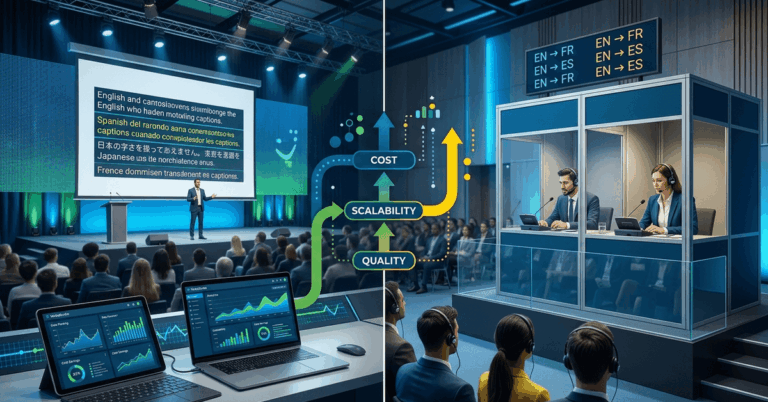
When captioning is available in multiple languages simultaneously, you effectively open your event to audiences who would otherwise be excluded entirely. A product launch, training summit, or investor event that previously required separate language tracks or interpreter hardware can now serve every language group from a single production workflow.
Organizations hosting global town halls or international conferences report attendance increases of 20-35% when multilingual captioning is promoted as a feature during registration. That is not a marginal improvement — it fundamentally changes the event’s reach.
Engagement Metrics: How Captions Change In-Event Behavior
Attendance is only half the equation. The other half is whether attendees actually engage with your content. Live captioning demonstrably improves comprehension, retention, and active participation.
Comprehension and Retention Improvements
Research from the University of South Florida and Oregon State University has consistently shown that captions improve information retention. In educational settings, captioned content produces retention rates 10-20% higher than uncaptioned content. Corporate events operate on the same cognitive principles — attendees absorb more when they can both hear and read the content simultaneously.
This effect is amplified in challenging acoustic environments. Large ballrooms, convention halls, and outdoor venues all introduce audio quality variables. Captions provide a reliable fallback that keeps attendees engaged even when the audio experience is imperfect.
Session Participation and Q&A Activity
Event teams that implement live captioning frequently report higher participation rates during Q&A segments and interactive sessions. The mechanism is straightforward: when attendees understand the content more completely, they are more prepared to ask questions, contribute to discussions, and engage with polls or surveys.
For hybrid events, the effect is even more pronounced. Remote attendees who rely on captions to follow the session are significantly more likely to submit questions and participate in chat discussions than those watching uncaptioned streams.
Engagement ROI You Can Measure
Engagement Metric | Without Live Captions | With Live Captions |
|---|---|---|
Average session watch time (hybrid attendees) | 55-65% of session length | 75-85% of session length |
Q&A participation rate | 8-12% of attendees | 15-22% of attendees |
Post-session survey completion | 20-30% | 30-40% |
Reported content comprehension (self-assessed) | 70-75% | 85-92% |
These figures are composites drawn from published event industry studies and platform analytics. Your specific numbers will vary based on audience composition and event format, but the directional trend is consistent: captions improve every engagement metric that event teams track.
Post-Event Content Value: The ROI That Keeps Compounding
One of the most overlooked dimensions of live captioning ROI events generate is the post-event content asset. Every captioned session produces a transcript — and that transcript becomes a foundation for content that extends the event’s value for weeks or months after the doors close.
Searchable Transcripts and Knowledge Libraries
A professionally generated transcript from each session can be published as a searchable document within your organization’s knowledge base, intranet, or event platform. Attendees can revisit specific segments. Non-attendees can access the content. Leadership can review key presentations without watching full recordings.
For organizations that host recurring events — annual conferences, quarterly town halls, training summits — this creates a compounding knowledge library that grows more valuable over time.
Content Repurposing Pipeline
A single session transcript enables a range of derivative content:
- Blog posts and article summaries drawn from speaker presentations
- Social media quotes and highlight clips with accurate captions baked in
- Multilingual versions of session recordings for global distribution
- Compliance documentation for regulated industries
- Training materials sourced directly from live sessions
Without captioning, creating this content requires manual transcription — a process that is slow, expensive, and often inaccurate for technical or specialized content. With live captioning already in place, the transcript exists the moment the session ends.
Estimating Post-Event Content Value
Consider what it costs to produce this content from scratch versus extracting it from an existing transcript:
Content Type | Cost to Produce from Scratch | Cost to Produce from Transcript |
|---|---|---|
60-minute session transcript | $150-$300 (manual transcription) | $0 (already generated) |
Blog summary of keynote | $300-$600 (writer + research) | $75-$150 (editing only) |
Multilingual session recording (3 languages) | $1,500-$3,000 (interpretation + post-production) | Included with multilingual captioning |
Searchable session archive (10 sessions) | $2,000-$4,000 (transcription + formatting) | $200-$500 (formatting only) |
For a multi-day conference with 20-30 sessions, the content savings alone can exceed the cost of the captioning service.
Building the Live Captioning ROI Events Business Case for Leadership
When you present the captioning investment to leadership, structure the case around three categories: audience expansion, engagement improvement, and content value. Avoid framing it purely as an accessibility compliance measure — not because compliance is unimportant, but because the business case is stronger when compliance is one benefit among several.
A Framework for the Budget Proposal
Use this structure when building your internal proposal:
The first section should address the problem: quantify the audience segments currently underserved by your events. Use internal data if available — survey results about language preferences, accessibility accommodation requests, hybrid attendance drop-off rates.
The second section should present the solution with cost clarity. Outline the captioning investment with specific pricing, and map it against the expected attendance and engagement improvements using the benchmarks in this post.
The third section should project the content value. Estimate the post-event content you currently produce manually, calculate the cost savings from transcript-based workflows, and show the compounding value over multiple events per year.
Cost-Per-Attendee Perspective
One of the most effective reframing techniques is cost-per-attendee analysis. If your event budget is $200,000 for 1,000 attendees, your cost-per-attendee is $200. Adding live captioning at $2,000-$5,000 adds $2-$5 per attendee — while potentially increasing your audience by 15-30% and improving engagement metrics across the board.
That is not an expense. That is leverage.
Compliance and Risk Mitigation: The Baseline Argument
While the business case for captioning is strong on its own, the compliance dimension provides a floor of justification that makes the investment defensible regardless of the engagement data.
Regulatory Landscape
The Americans with Disabilities Act (ADA), Section 508 of the Rehabilitation Act, and equivalent regulations in the EU, Canada, and Australia establish obligations for accessible communication at events hosted by government agencies, educational institutions, and organizations receiving federal funding. Many corporate events fall within these requirements, and the trend is toward broader application, not narrower.
Reputational Risk
Beyond formal compliance, there is a reputational dimension. An attendee who cannot access your content due to missing captions will share that experience. In an era where accessibility expectations are rising across all demographics, the absence of captioning is increasingly noticed — and commented on publicly.
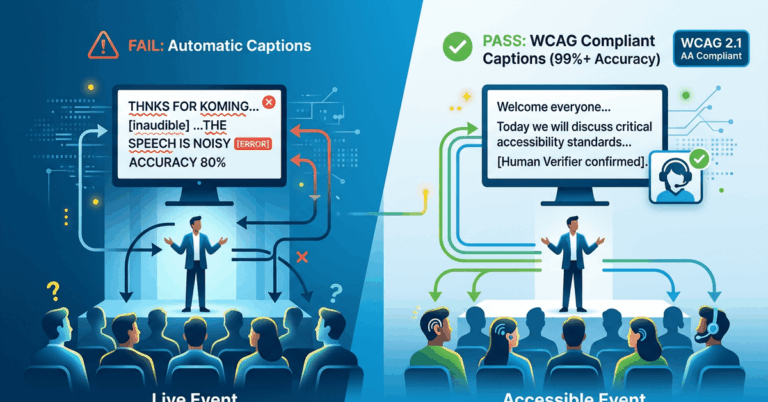
Professional captioning eliminates this risk entirely and signals that your organization takes inclusion seriously at a production level, not just a policy level.
The cumulative case for live captioning ROI at events is clear. You expand your audience by removing language and hearing barriers. You improve engagement by giving every attendee a second channel for comprehension. You generate a content asset that compounds in value long after the event ends. And you mitigate compliance and reputational risk as a baseline.
For event teams ready to implement professional live captioning, VerbalScribe provides enterprise-grade real-time transcription and multilingual translation built specifically for live event environments. The platform integrates with professional AV workflows, supports multiple simultaneous languages, and delivers the reliability that high-stakes events require. If you are building the business case for captioning at your next event, the data supports you — and the right technology makes execution straightforward.
Frequently Asked Questions
What is live captioning ROI, and how is it measured at events?
Live captioning ROI measures the return on investment from adding real-time captions to events. It is calculated across three categories: audience expansion (increased attendance from underserved populations), engagement improvement (higher session watch times, Q&A participation, and content comprehension), and post-event content value (cost savings from transcript-based content repurposing versus manual transcription and translation).
How much does live captioning cost for a corporate event?
Costs vary depending on the number of sessions, languages, and event duration. Professional live captioning for a single-day corporate event typically ranges from $1,500 to $5,000. When calculated on a cost-per-attendee basis, this usually adds $2 to $10 per person — a fraction of total event production costs while delivering measurable improvements in reach and engagement.
Does live captioning actually increase event attendance?
Yes. Events that promote multilingual captioning and accessibility features during registration consistently report attendance increases of 15-35%, particularly among non-native speakers, remote attendees, and individuals with hearing loss. The increase is most significant for global or hybrid events where language diversity is a factor.
Can live event transcripts be repurposed into other content?
Absolutely. Transcripts generated during live captioning serve as a foundation for blog posts, article summaries, searchable session archives, multilingual recordings, social media content, training materials, and compliance documentation. This content pipeline significantly reduces post-event production costs compared to creating these assets from scratch.
What is the difference between live captioning and post-event transcription?
Live captioning delivers text in real time during the event, enabling immediate accessibility for attendees who are deaf, hard of hearing, or non-native speakers. Post-event transcription is produced after the event concludes and is used for archival and content purposes. Professional live captioning platforms like VerbalScribe provide both: real-time captions during the event and a transcript available immediately afterward.
How does multilingual captioning work at live events?
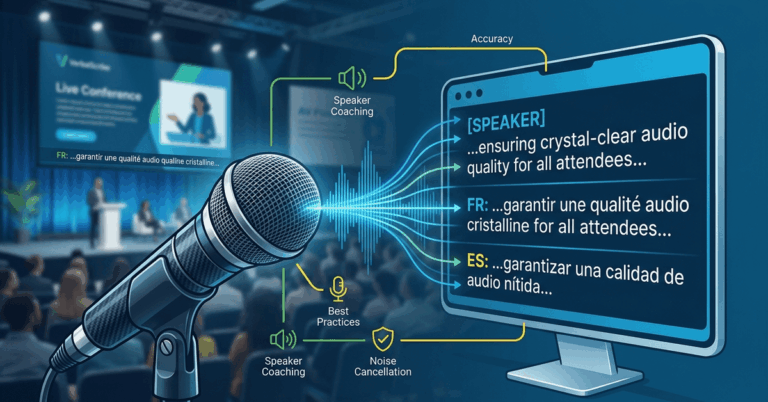
Multilingual captioning uses real-time translation technology to convert a speaker’s words into multiple languages simultaneously. Attendees select their preferred language on a personal device or display screen. This replaces the need for traditional interpretation hardware and allows organizations to serve global audiences from a single production setup.
Do I need special equipment to add live captioning to my event?
Most professional captioning platforms require only an audio feed from your existing production setup and a network connection. Platforms designed for live event environments integrate with standard AV workflows, including tools like ProPresenter and Dante audio networks. The technical requirements are straightforward for any experienced production team.