
VerbalScribe vs. Traditional Interpretation Booths: Cost, Scalability, and Audience Experience Compared
When your next conference needs to reach audiences in five, ten, or twenty languages, the decision between traditional interpretation booths and AI-powered translation platforms is no longer a question of novelty versus tradition. It is a question of logistics, budget, scalability, and audience experience. The comparison of AI translation vs interpretation booths has shifted dramatically in recent years, and event professionals owe it to their organizations — and their attendees — to understand the real tradeoffs.
Here is the direct answer: for most multi-language live events, an AI-powered platform like VerbalScribe delivers comparable or superior audience coverage at a fraction of the cost, without the logistical burden of physical booths, headset distribution, and per-language interpreter staffing. Traditional booths still have a place in high-stakes diplomatic or legal settings, but for conferences, corporate events, university lectures, galas, and houses of worship, the calculus has changed.
This comparison breaks down the specifics — cost per language, scalability across simultaneous tracks, how audiences actually access translations, and where a hybrid AI-plus-human approach fits — so you can make an informed decision for your next event.
How Traditional Interpretation Booths Work — And Where They Hit Limits
Simultaneous interpretation has been the standard for multilingual events since the Nuremberg Trials in 1945. The setup is well understood: soundproof booths are placed at the rear or side of a venue, each staffed by at least two interpreters per language pair. Attendees receive wireless headsets tuned to their preferred language channel.
This model works. It has worked for decades. But it carries significant constraints that become more pronounced as event scale and language requirements grow.
Staffing and Scheduling Complexity
Each language requires a minimum of two interpreters who rotate every 20 to 30 minutes to maintain accuracy. For a full-day conference in five languages, that means at least ten interpreters on-site, each requiring preparation materials, briefings, and line-of-sight or audio feeds to the stage. Interpreter availability can be limited for less common language pairs, and last-minute language additions are nearly impossible.
Physical Infrastructure
Each booth requires floor space, power, a clear audio feed from the house sound system, and a dedicated transmission channel. Venues must accommodate the footprint. For multi-room or multi-track conferences, booths must be replicated or interpreters must move between rooms — introducing gaps in coverage.
Headset Distribution and Hygiene
Every attendee who needs translation must pick up a headset, often requiring a deposit or ID exchange. After the event, headsets are collected, cleaned, and inventoried. Lost or damaged units add cost. Since 2020, many attendees are also reluctant to use shared audio equipment.
AI Translation vs Interpretation Booths: A Direct Cost Comparison
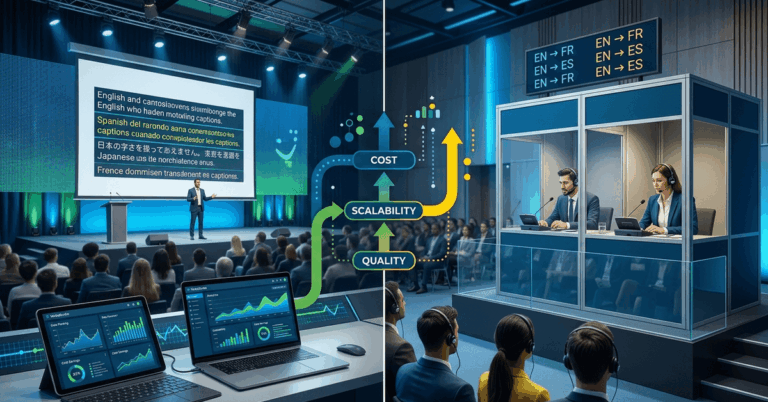
Cost is often the first consideration for event producers evaluating AI translation vs interpretation booths. The difference is substantial and scales in opposite directions: traditional interpretation gets more expensive with each additional language, while AI-powered platforms add languages at marginal cost.
The following table provides a representative comparison for a single-day, eight-hour conference. Actual costs vary by region, language pair, and vendor, but these figures reflect typical ranges reported by event production professionals.
Cost Factor | Traditional Booths (per language) | VerbalScribe (platform) |
|---|---|---|
Interpreter fees (2 per language, per day) | $2,000 – $4,000 | Included in platform |
Booth rental and setup | $1,500 – $3,000 | Not required |
Headset rental (per attendee) | $5 – $15 each | Not required — attendees use personal devices |
Audio/RF transmission equipment | $500 – $1,500 | Not required |
Technician for booth coordination | $500 – $1,000 | Minimal — managed through platform dashboard |
Additional language (incremental) | $4,500 – $9,500 per language | Marginal platform cost per language |
Setup time | 2 – 4 hours minimum | Under 30 minutes typical |
For a five-language event with 500 attendees, the traditional booth model can easily exceed $30,000 to $50,000. A platform-based approach brings that figure down dramatically while removing most of the logistical coordination.
Where Cost Savings Compound
The savings become even more significant in multi-day or multi-track scenarios. A three-day summit with four concurrent breakout rooms would require interpreter teams and booth equipment in every room for every day. With a cloud-based platform, a single deployment covers all rooms and all days, with language options available across every session without replication of physical infrastructure.
Scalability Across Languages, Sessions, and Venues
Scalability is where AI-powered platforms fundamentally change the equation. Traditional interpretation is linear — every new language, room, or session requires proportional increases in staff and equipment. Platform-based translation scales logarithmically.
Adding Languages Without Adding Complexity
VerbalScribe supports real-time output in multiple languages simultaneously. Adding a sixth, tenth, or twentieth language does not require a new booth, a new interpreter team, or a new headset channel. It requires a configuration change in the platform. This makes it practical to offer language access that would be financially prohibitive under the traditional model.
Consider a university commencement ceremony with families attending from dozens of countries. Offering interpretation in three languages through booths might be feasible. Offering it in fifteen languages is not — unless the approach changes entirely.
Multi-Track Conference Coverage
Large conferences routinely run four to eight concurrent sessions. Providing simultaneous interpretation in every breakout room through traditional booths is cost-prohibitive for most organizations. With a platform-based model, every session can offer multilingual captions through the same deployment. Attendees simply select their language on their personal device, regardless of which room they are in.
Hybrid and Live-Stream Events
Traditional booths serve in-room attendees only. Remote participants on a live stream require a separate interpretation feed, adding another layer of complexity and cost. VerbalScribe delivers translations to any device with a browser — in the room, at home, or across time zones — through a single unified workflow.
Audience Experience: Personal Devices vs. Fixed Headsets
The way attendees receive translated content matters. It affects participation rates, comfort, and perception of the event.
The Headset Model
Traditional headsets are effective but introduce friction. Attendees must visit a distribution desk, wait in line, and carry an additional device. Many choose not to bother, especially if they have partial proficiency in the event’s primary language. The result: translation services go underutilized despite the investment.
Headsets also create a visible distinction between attendees — those wearing headsets and those who are not. For events that prioritize inclusion, this can work against the intended goal.
The Personal Device Model
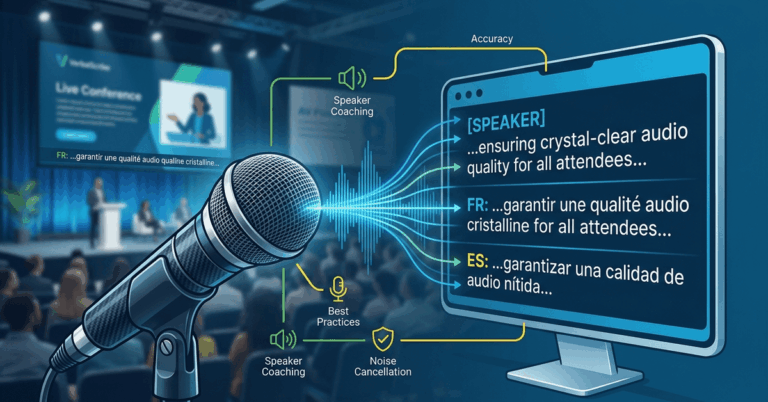
When translations are delivered directly to each attendee’s smartphone, tablet, or laptop, the barrier to access drops to nearly zero. Attendees scan a QR code or visit a URL, select their language, and begin receiving captions in real time. There is no line, no deposit, no shared equipment.
This model also enables features that headsets cannot provide: scrollable caption history, adjustable text size, and the ability to switch languages mid-session without raising a hand or swapping a channel.
Accessibility Beyond Language
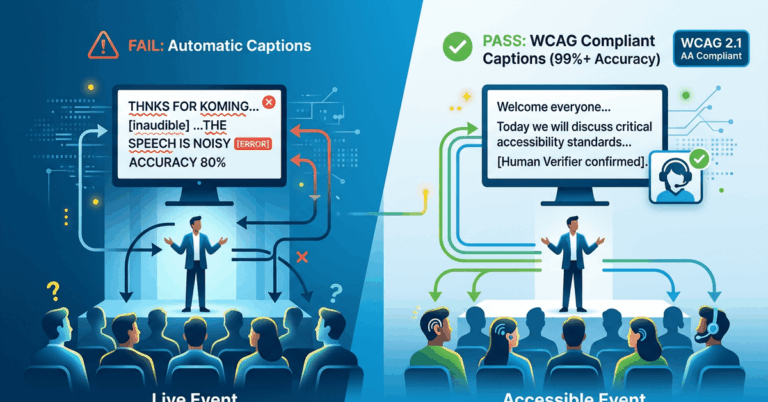
Real-time captions serve more than multilingual audiences. Attendees who are deaf or hard of hearing benefit from the same caption stream in the event’s primary language. This dual-purpose accessibility — language access and hearing access — is a significant advantage of caption-based platforms over audio-only interpretation.
AI Translation vs Interpretation Booths: The Hybrid Approach
A common concern from event professionals evaluating AI-powered translation is accuracy. Machine translation has improved enormously, but live events introduce challenges: specialized terminology, speaker accents, fast-paced delivery, and domain-specific jargon.
This is where a hybrid model matters. VerbalScribe is not a raw machine translation engine. The platform is built for live event environments and supports workflows where AI handles the real-time processing while human oversight ensures accuracy for critical content.
When AI Alone Is Sufficient
For general session content, panel discussions, and presentations with standard business or academic vocabulary, AI-powered transcription and translation delivers professional-grade output. The technology handles speaker transitions, filters filler words, and produces readable caption streams across languages.
When Human Review Adds Value
For events with highly specialized terminology — medical conferences, legal proceedings, technical product launches — a human reviewer can monitor and correct the AI output in real time. This hybrid model preserves the speed and scalability of AI while adding a layer of accuracy assurance that matches or exceeds what a solo human interpreter can deliver under fatigue.
Eliminating the Single Point of Failure
A traditional interpreter is a single point of failure. If an interpreter loses focus, mishears a term, or needs an unscheduled break, the audience loses coverage. An AI platform operates continuously without fatigue. When combined with human oversight, the result is a redundant, resilient system — the kind of reliability that live events demand.
Making the Right Choice for Your Event
Not every event has the same requirements, and the choice between traditional interpretation and AI-powered translation is not always binary. Here is a practical framework for deciding.
Traditional booths may still be the right choice when:
- Regulatory or diplomatic protocols require certified human interpreters
- The event involves two or fewer languages with readily available interpreter teams
- The venue already has permanent booth infrastructure
- Attendees do not have reliable access to personal devices
AI-powered platforms like VerbalScribe are the stronger choice when:
- The event requires three or more languages
- Multiple concurrent sessions need coverage
- The event includes a hybrid or live-stream component
- Budget constraints make per-language interpreter staffing impractical
- The event prioritizes accessibility for both multilingual and deaf or hard-of-hearing attendees
- Setup time and logistical simplicity are priorities
- The organization hosts recurring events and needs a scalable, repeatable solution
For event professionals who have relied on traditional booths and are evaluating a shift, VerbalScribe offers the kind of production-grade reliability that live events require — without the logistical overhead that makes multilingual access prohibitively complex.
The comparison of AI translation vs interpretation booths is no longer about choosing between a proven method and an unproven experiment. It is about choosing between a model designed for a pre-digital world and one built for how modern audiences actually attend, participate in, and experience live events. VerbalScribe is built for the latter — and for the production teams who make those events happen.
If your next event serves a multilingual or accessibility-focused audience, a conversation with the VerbalScribe team can help you map the right approach for your specific setup, audience size, and language requirements.
Frequently Asked Questions
Is AI-powered translation accurate enough for professional live events?
Modern AI transcription and translation platforms built for live events deliver professional-grade accuracy for general business, academic, and conference content. For specialized terminology, a hybrid model with human oversight further improves accuracy. VerbalScribe is designed specifically for live event environments, where reliability and readability are essential.
How many languages can VerbalScribe support simultaneously?
VerbalScribe supports real-time output in multiple languages simultaneously during a single event. Unlike traditional interpretation, adding languages does not require additional physical infrastructure or proportional increases in staffing. The exact number of supported languages depends on the platform plan and event configuration.
Do attendees need to download an app to access translations?
No. VerbalScribe delivers real-time captions and translations through a web-based interface. Attendees access the service by scanning a QR code or visiting a URL on their personal smartphone, tablet, or laptop. No app download is required.
Can VerbalScribe integrate with existing AV production workflows?
Yes. VerbalScribe is built for professional event production environments and supports integration with tools like ProPresenter and Dante audio workflows. The platform is designed to fit into existing technical setups rather than requiring production teams to change their workflow.
What happens if the internet connection is unreliable at the venue?
VerbalScribe is built with the understanding that live events operate in varied network conditions. The platform is designed for resilience, and the VerbalScribe team can advise on network configuration and redundancy planning as part of pre-event preparation. Reliable connectivity is a shared priority, and proper network planning is part of the deployment process.
How does the cost of VerbalScribe compare to hiring interpreters for a small two-language event?
For a single event in two languages, traditional interpretation may be cost-competitive depending on interpreter availability and whether booth infrastructure is already in place. The cost advantage of VerbalScribe becomes most pronounced at three or more languages, multi-day events, multi-track conferences, and recurring event schedules where the logistical and financial overhead of booths compounds significantly.
Does VerbalScribe support accessibility for deaf and hard-of-hearing attendees?
Yes. Real-time captions in the event’s primary language serve attendees who are deaf or hard of hearing, using the same platform that delivers multilingual translations. This dual-purpose accessibility means a single deployment addresses both language access and hearing access requirements.